
This fall marks the end of our second year of the Kellogg Creek Student Macroinvertebrate Monitoring Program, and the momentum is growing! Many student volunteers are now joining us for their 2nd or 3rd time surveying! Building on skills developed during previous seasons, students are becoming more confident in sampling, identification, and data collection, allowing us to gather increasingly robust and reliable data. At the same time, our volunteer community continues to expand, providing essential support that helps make each survey day a success.
This season, we continued our partnerships with Milwaukie High School, Rowe Middle School and Portland Waldorf School, while further growing our weekend Community Surveys which create opportunities for new and returning volunteers to supplement student-collected data and deepen their connection to Kellogg Creek. Together, students and volunteers are collecting critical pre-restoration baseline data that will help us understand macroinvertebrate communities and overall stream health ahead of the planned removal of Kellogg Dam.
With a full two years of surveys now behind us, we can begin comparing results across seasons and years, strengthening both our dataset and our learning outcomes. Our goal is to continue building this program by supporting students as they refine their skills and expanding volunteer involvement, while collecting several more years of pre-restoration data leading up to the removal of Kellogg Dam in 2028.
A big THANK YOU for this season goes out to:
- Elliot Cameron and the Milwaukie High School biology students
- Matt Kemis, Dylan Richmond, Violet Malmros, Rachel Hutson and the Rowe Middle School 6th, 7th and 8th graders
- Shannon Casey and the Portland Waldorf School zoology students
- Entomologist Zee Searles Mazzacano, pHD, CASM Environmental
- Educate Ya and IRCO who provided translations and interpreters for the program
- And all of our macroinvertebrate survey volunteers!
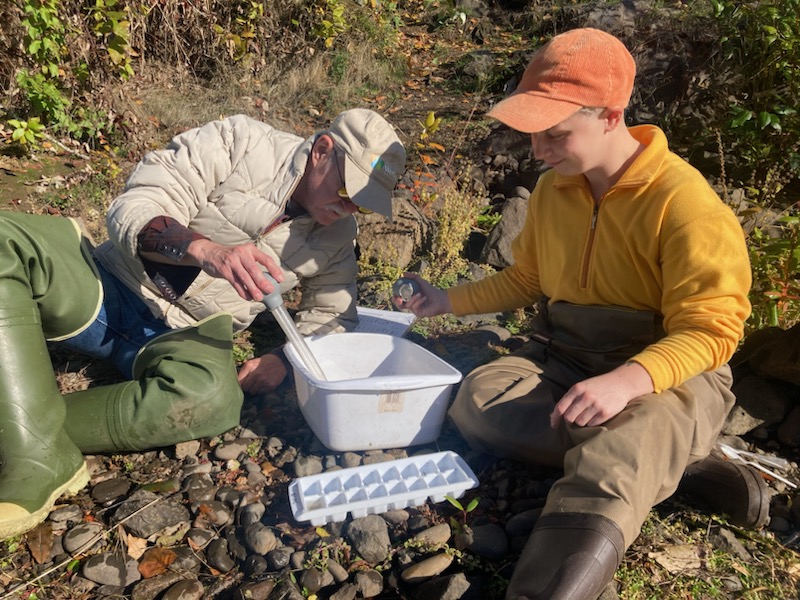
Volunteers on a Community Survey sorting macroinvertebrates collected at the Kellogg Creek confluence with the Willamette River.
Survey Results
We conducted surveys at 4 sites: the confluence of Kellogg Creek and Willamette River, in the Kellogg Impoundment from Dogwood Park and the Milwaukie Presbyterian Church Sanctuary, and upstream of the impoundment behind Rowe Middle School. In addition to surveys conducted with classrooms from Milwaukie High School and Rowe Middle School, we held two weekend community surveys at the Kellogg/Willamette confluence site to supplement classroom data.
For more information on survey and analysis methods, check out the Fall 2024 results page here.
Survey Effort
The table below summarizes the number of surveys at each each site, the total number of samples collected at the site, the average number of macroinvertebrates counted during a survey, and the average number of macroinvertebrates counted per number of samples collected. Something that we keep in mind when looking at our data is the amount of “effort” put into each site – how many surveys were at the site and the number of samples that were collected. One thing that has been apparent from the last few seasons of monitoring is that surveys at Rowe Middle School often have greater amount of effort, both due to a larger number of surveys and larger class sizes which result in more samples being collected. When effort is skewed across survey sites, it can make it more difficult to make comparisons between them. With lower sampling effort you may not collect enough samples to fully represent the diversity of a site, and miss some of the more rare taxa that could be present. In future seasons, we will continue to work with teachers and community members to more evenly distribute our survey effort, with increased community surveys used to supplement student data.
| Survey Sites | Number of Surveys | Number of Samples Collected | Mean Macroinvertebrate Counts | Mean Abundance/Samples Collected |
| Kellogg Creek (Willamette Confluence) | 2 | 21 | 118 | 11.2 |
| Kellogg Impoundment | 5 | 69 | 51.5 | 2.5 |
| Kellogg Creek (Rowe) | 18 | 378 | 217.6 | 2.9 |
This season we had to cancel two of our scheduled Community Surveys, which meant survey effort at the Kellogg Creek/Willamette Confluence site was low. Mean macroinvertebrate counts varied across sites, with the highest counts found at the Rowe Middle School site. When survey effort is accounted for (mean abundance/number of samples collected), the Kellogg Creek/Willamette Confluence appears to have the highest abundance of macroinvertebrates per sample. We have seen consistently mean abundance per sample results at the Willamette Confluence site due to a large abundance of isopods collected each season.
Survey Findings
The table below summarizes interesting findings from our survey season, including total taxa abundance at each site and which taxa was most abundant. The percentage of mayflies, stoneflies and caddisflies found at each site ( %EPT ) and percent midges. A high percentage of EPT may indicate a healthier stream, whereas over 30 % midges generally indicates a more degraded habitat.
| Survey Site | Taxa Richness | Most Abundant Taxa | % EPT | % Midges |
| Kellogg Creek (Willamette Confluence) | 15 | Sowbug | .85% | 5.93% |
| Kellogg Impoundment | 13 | Sowbug | 0% | 1.73% |
| Kellogg Creek (Rowe) | 21 | Scud | 11.67% | 2.94% |
Data Analysis
Below are the results of the Community Science Index of Biotic Integrity. On this index higher scores are associated with healthier streams, so the sites that are represented in red are considered impaired, while the green and yellow sites are healthy and moderately impaired respectively.
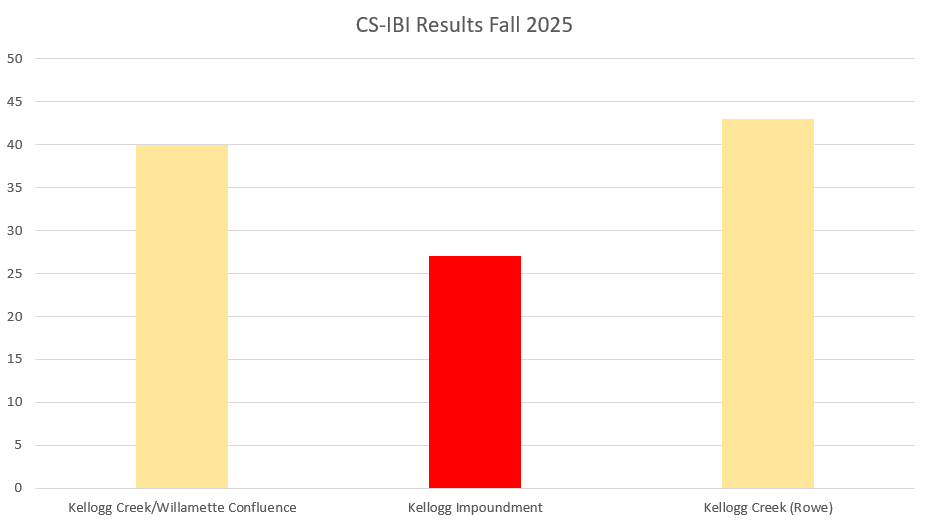
The chart above shows the average CS-IBI score at each survey site, with the two sites within the Kellogg Impoundment (Milwaukie Presbyterian Outdoor Sanctuary and Dogwood Park) combined. As we move through our second year of seasonal monitoring, we are now able to compare results across both years and seasons to better understand patterns in stream health.
In Fall 2025, sites within the Kellogg Impoundment continued to score in the impaired range (27), which is consistent with results from both Fall 2024 and Spring 2025. These consistently low scores indicate ongoing degraded biological conditions in areas of Kellogg Creek that are strongly impacted by the dam.
At the Kellogg Creek/Willamette River confluence, Fall 2025 results placed the site in the moderately impaired category. This is aligned with the overall assessment from Fall 2024, although the site scored notably higher (65) within that category in 2024. Interestingly, in Spring 2025, the site fell within the impaired range with an average CS-IBI score of 32. Continued seasonal monitoring at this site will help us better understand longer-term patterns and seasonal variability in biological conditions at the confluence.
The Rowe Middle School site, located along a free-flowing section of Kellogg Creek upstream of the impoundment, again scored higher than the impounded sites in Fall 2025 and was classified as moderately impaired. This result is consistent with both Fall 2024 and Spring 2025, when the Rowe site also fell within the moderately impaired range. While scores at this site fluctuate seasonally and year to year, the data continue to show that the free-flowing reach supports stronger biological integrity than areas of the creek impacted by Kellogg Dam.
We will continue to collect seasonal (fall and spring) macroinvertebrate data at these sites in the years leading up to and following the removal of Kellogg Dam in 2028, allowing us to track changes in stream health over time and evaluate biological responses to restoration.
 ncwatersheds.org